Equipment photographs · 3
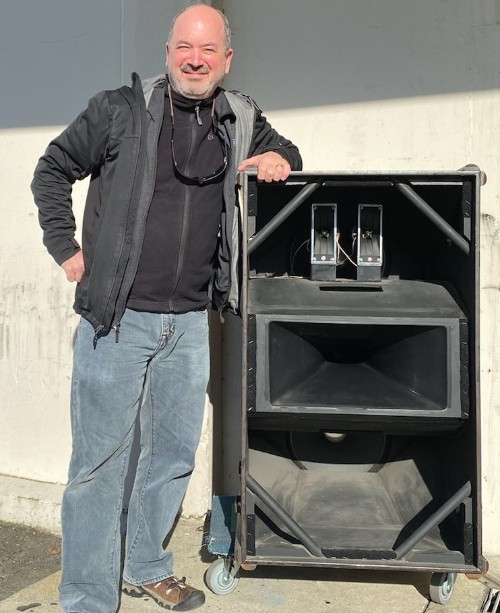
1 / 3 · Michael ‘Bink’ Knowles with a McCune JM-3
Michael ‘Bink’ Knowles with a McCune JM-3·Published by ProSoundWeb; photographer and original rights holder not credited·Copyright retained by the original rights holder; reproduced for identification and historical commentary (fair use). Reuse permission not established.Why it mattered
- 01
In 1971 Harry McCune, Jr. was losing money re-coning blown drivers and stacking ever more Altec boxes to reach the levels large pop audiences demanded. When the big U.S. manufacturers declined to build him a tougher loudspeaker, he turned to John Meyer, whose Glyph system at Pepperland in San Rafael he had heard about.
- 02
Holding a blown Altec 604, McCune asked Meyer for a three-way loudspeaker in one enclosure, small enough for a jet cargo hold, as clean as the 604 but ten times louder. Chief engineer Bob Cavin supervised the project and carpenter John Burke solved the enclosure problems; the box was named for Meyer’s initials and its three bandpasses.
- 03
Roxy Music mixer Chris Michie, a former AIR Studios tape op, later called the horn-loaded JM-3 the “gold standard of ‘70s integrated sound systems.” After its success Meyer went to research acoustics in Montreux, where he patented a low-distortion compression driver.
- 04
McCune refused to sell the JM-3, keeping it as a rental item for top clients; the costly project nearly broke the company, and the policy limited the design’s reach. Clair Brothers heard a JM-3 at a stadium event before developing its S4, and Showco followed with the Pyramid, precursor to the Prism.
- 05
Integrated, processor-tuned loudspeakers only went on sale when Meyer Sound reworked the idea into the UM-1 UltraMonitor for Jefferson Starship in 1979. Meyer’s MSL-3 and MSL-10 descend directly from the JM-3 and JM-10, and the UPA, created in 1980 at Abe Jacob’s request for Broadway, is a less obvious descendant.
- 06
Kennedy's FOH survey describes the JM-3 as an active, pre-packaged three-way system with dedicated external processing and electronics.
Engineering record
- Drivers
- Two horn-loaded 15-inch Altec 421A woofers; one heavily modified Altec 290 mid driver on a Meyer-designed exponential horn, flanked by the woofers in the same vertical plane for time alignment; two Electro-Voice T350 tweeters.[3]
- Enclosure
- 45 × 26 × 32 inches (H × W × D), Baltic birch ply with extra bracing; first box weighed 245 lb. Production wood cut by Hard Truckers, mid horns moulded in fibreglass, final assembly at McCune’s shop.[3]
- Amplification
- Passive box driven externally by three Crown amplifiers (DC-300 lows, DC-150 mids, DC-60 highs), modified by Cavin to drive two boxes per channel, via a four-conductor cable with Hubbell twist-lock connectors.[3]
- Processing
- One limiter per band, adapted from Meyer’s Glyph circuit, and Cavin’s zero-phase crossover upstream of the amps, avoiding the polarity flipping Meyer felt smeared timing.[3]
- Performance
- Crossovers around 400 Hz and 4 kHz; initially 70 Hz–14 kHz (±3 dB); 60° × 40° coverage.[3]
- 1976 revision
- After his Swiss research Meyer extended the range to 40 Hz–16 kHz, and his patented low-distortion compression diaphragm treatment (U.S. patent 4152552) went into all JM Series boxes.[4]
- Companion boxes
- JM-5 subwoofer with four Gauss 18-inch woofers; later JM-7 subwoofer in the JM-3’s cabinet size; JM-10 array (1977), sold as replacing ten JM-3s but in practice six, with bucket-brigade delay for high-frequency alignment.[4]
- Known flaws
- Forward-mounted high-frequency horns gave two apparent apexes, so side-by-side splays lobed and combed while vertical stacks arrayed well. Batches varied slightly; there were no true handles; worn wooden skids exposed screw heads. Heavy alnico mid drivers could snap fibreglass horn throats until 128 remaining boxes were retrofitted with metal-and-foam cradles.[4]
Original pricing
Not documented
2026 equivalent
Not calculated without a reliable original price.
No sourced price has been located.
Use in the field
Early 1972: Meyer demonstrated the finished box to McCune engineer Abe Jacob with Ringo Starr’s drum solo from “The End”; Jacob resolved to take it on his gigs. Herb Alpert heard prototypes at A&M Studios and insisted on buying them for the studio.[3]
The first gig is disputed: Hal Soogian recalls a March 1972 benefit at the San Francisco Jewish Community Center; Jacob names Joan Baez and Streisand’s April “Four for McGovern” concert at the L.A. Forum; Meyer names Creedence Clearwater Revival’s final tour, also from April.[3]
After a Grateful Dead show at Winterland, Bill Graham tried to buy the “bulletproof” system; McCune refused to sell, and Graham ended their business relationship.[3]
Jacob sent four JM-3s to fix the sound of Jesus Christ Superstar on Broadway — two over the proscenium, two flanking the stage — earning a Playbill sound design credit; Beatlemania (1977) later used four JM-3 mains.[3]
King Crimson toured North America on JM-3s in 1973; Roxy Music used three per side in 1974 and eight in 1975, enough for Wembley Arena.[3]
Arena and stadium shows used 12 or more boxes in three-over-three clusters per side. Rich Mowdy first flew JM-3s in Hawaii; McCune then adopted rigging belts held by bolted-on metal straps.[3]
1977: the JM-10 debuted on the Kool Jazz stadium tour with JM-3 out fills and a Cavin-designed hot-backup amplifier fail-over; it remained McCune’s largest concert system for two decades.[4]
Late 1970s: JM-3s toured South America with Burt Bacharach (1978), served Playboy Jazz at the Hollywood Bowl and Barry Manilow’s 1978 summer tour, the Monterey Jazz Festival and New Orleans Jazz and Heritage Festival venues. Devo hired a JM-3 and JM-10 rig for shows ending New Year’s Eve 1979 at Long Beach Arena.[4]
1980s: the JM-3 was McCune’s standard festival system, many boxes painted black; up to four sat above the proscenium of the Fairmont’s Venetian Room in San Francisco, where Tony Bennett sang.[4]
About 130 boxes were built. From 1982 the lighter two-way McCune SM-5 took over much routine work, and by the 2000s line arrays had made the JM-3 look old-fashioned. Allan McCune later had six revived as two-way boxes; four Venetian Room units remained with McCune, whose brand was phased out after Shepard Exposition Services bought the company in December 2017.[4]
Manuals & original documents
No authoritative manual or original document has been located for this profile.
Sources
- 1McCune Audio/Video/LightingWikipedia · reference
- 2Bob CavinWikipedia · reference
- 350 Years Ago: McCune & Meyer Create The JM-3 Integrated Concert Loudspeaker, Part 1 (Michael “Bink” Knowles)ProSoundWeb · reference
- 4The Development Of The McCune JM-3 Loudspeaker, Part 2: Additional Components (Michael “Bink” Knowles)ProSoundWeb · reference
- 5The History of P.A. Loudspeakers, Part 3 (David K. Kennedy, June 2025)FOH | Front of House · reference
- 6100 Loudspeaker Technologies that Changed Live-Sound History, Part 1 (David K. Kennedy, 6 September 2026)FOH · reference · 6 September 2026
Contribute to the record
Know more about JM-3?
Corrections, firsthand information, original documents, and credited photograph sources are welcome.