Equipment photographs · 1
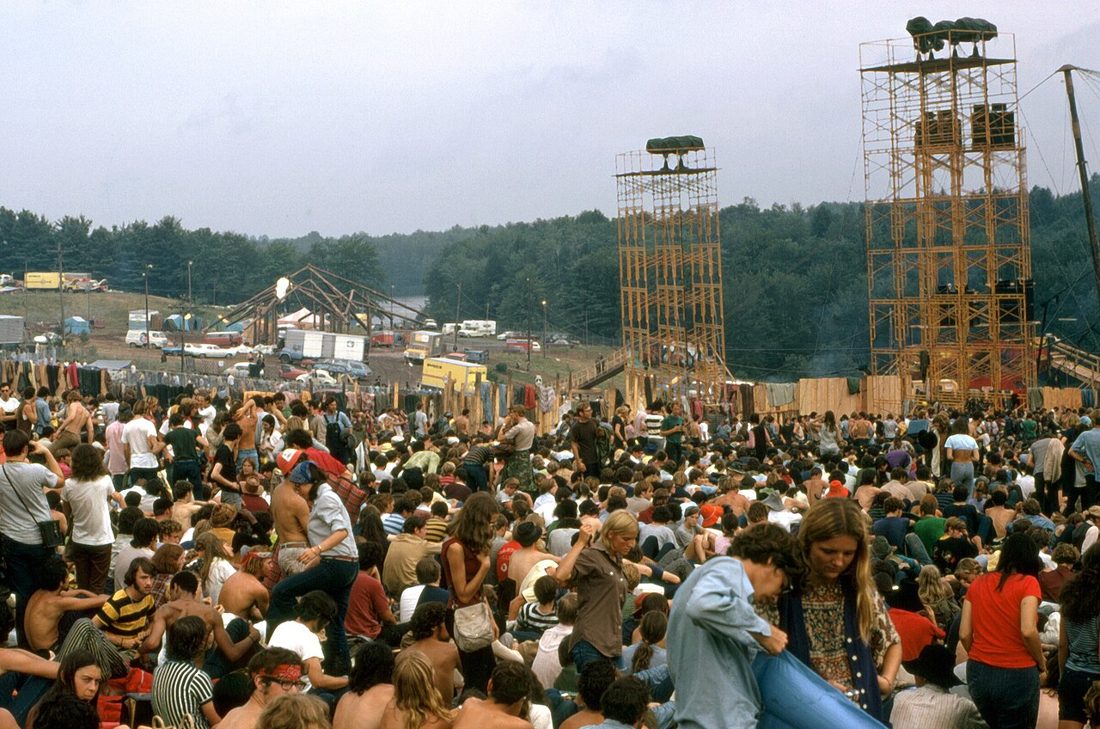
1 / 1 · The Woodstock sound towers, 1969
The Woodstock sound towers, 1969·James M Shelley·CC BY-SA 4.0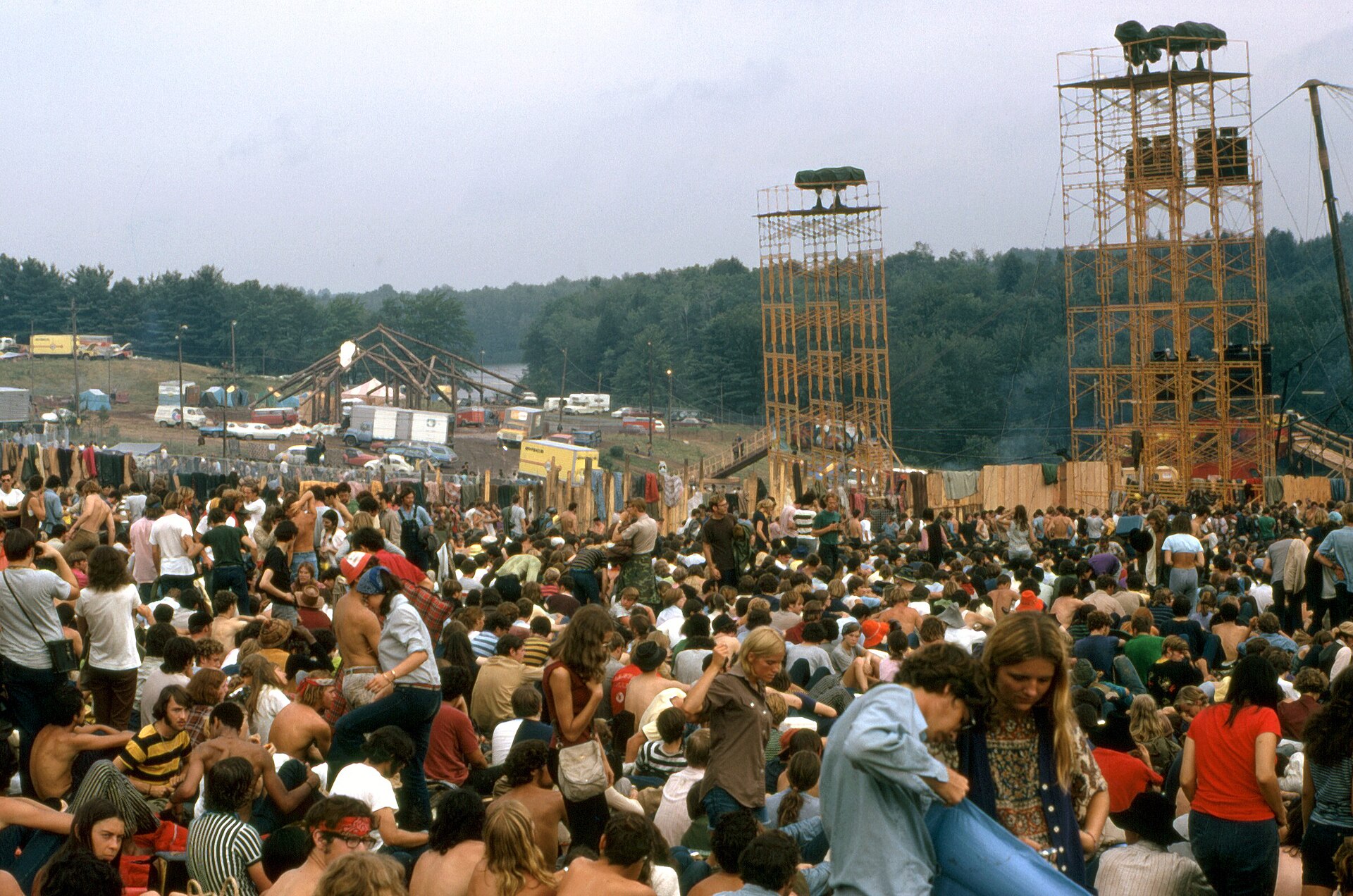
The surviving festival photograph shows the tall loudspeaker towers above the Woodstock audience.
Sound towers above the festival crowd, 1969·James M. Shelley·CC BY-SA 4.0Why it mattered
- 01
Demonstrated that intelligible amplified music and speech could be delivered across an unprecedented outdoor audience.
- 02
Made festival sound a visible engineering discipline rather than an enlarged club PA.
- 03
It was assembled from small parts rather than one big console: several Shure and Altec mixers, studio limiters and McIntosh hi-fi amplifiers were combined to drive custom Hanley Sound cabinets. This was the improvised signal chain that later touring consoles and amplifier racks replaced.
- 04
The PA also carried the stage announcements to a crowd that was largely cut off from other communication. Production head and emcee John Morris spoke through it, so the system served the event's logistics as well as the music.
Engineering record
- System design
- Hanley Sound built custom horn-loaded loudspeaker towers and coverage for the Bethel site rather than relying on a standard commercial package.[2]
- Bass cabinets
- Custom HSI 410 (Hanley Sound Inc.) enclosures of marine-grade plywood. FOH describes four upper bins, each with four 15-inch JBL D130 drivers, and four lower bins, each with four 15-inch JBL D140 drivers. A pair of upper bins measured roughly 6 × 4 × 7 feet and weighed nearly 1,000 pounds. Hanley's own quoted recollection in the same article ("about 32 woofers") does not match this inventory cleanly, so no system-wide driver total is given here.[3]
- High-frequency horns
- Altec 1003B 5 × 2 multicell horns plus Hanley's own 2 × 2 horns, all driven by Altec 290 compression drivers.[3]
- Crossover
- No original setting sheet survives in the sources checked. A published 50 Hz / 8 kHz figure is disputed on technical grounds by ProSoundWeb forum contributors, whose suggested 500–800 Hz points are later inference, not documentation.[6]
- Amplifiers
- Hanley recalled more than 20 McIntosh MC3500 tube amplifiers, rated at 350 watts each, under the stage, and FOH describes the total as over 10,000 watts. Mix reports that both tube and transistor McIntosh amplifiers were there, so an exact count and model mix are not settled.[3][4]
- Mixing and processing
- Four modified Shure M67 microphone mixers with input pads, two Shure M63 Audio Master equalisers, one Altec 1567A tube mixer, and four Teletronix LA-2A tube limiters between the mixers and the power amplifiers.[3][2]
- Microphones
- Shure historian Michael Pettersen identifies the microphones visible in the film and photographs as Model 565 Unispheres, apparently fitted by Hanley with Switchcraft adapters to convert them to XLR. Shure's factory XLR version, the 565D, came only in 1972. Hanley's later recollection in FOH names modified Shure Unidyne microphones instead, so the two accounts differ.[2][3]
- Ice-cooling story
- McIntosh president Charlie Randall rejects the often-repeated claim that blocks of ice cooled the amplifiers: melting water would have endangered the electronics.[5]
- Not yet documented
- Stage monitors, cable lengths and gauges, the snake, generator and electrical supply, Hanley's fee, and a full crew list. None of these is confirmed by a checked source.
Original pricing
No reliable build cost located
2026 equivalent
Not calculated without a reliable original price.
Published claims about the system's expense lack a sufficiently clear primary cost record.
Use in the field
Bill Hanley brought experience from the Newport Folk Festival and Fillmore East to the August 1969 Woodstock production.[3]
Hanley recalled about 30 days of planning. Shure notes that the stage and towers went up only days before the 15 August opening.[5][2]
The sound crew was about 12 people by FOH's count. WiFi HiFi says eight to ten ran the audio during the concert. Crew member David Marks photographed Hanley at the mix position.[3][5][4]
Intermittent rain pushed the festival into a fourth day. Hanley recalled that the sound system was among the services that kept working.[2]
Lee Osborne and Eddie Kramer worked on the recording in a backstage trailer, separate from the PA mix.[3]
Festival site plan
Where the equipment stood, as described by the sources below. Tom Jablonka's original August 1969 site and stage plans survive, reproduced in Bethel Woods' Cultural Landscape Report (Plans 6 and 7). They are under copyright and not reproduced here; the report notes that what was built sometimes differed from the plans.
- Speaker towers
- Two stand-alone scaffold towers south of the stage, set on below-grade concrete footings. They were shared with lighting.[7]
- Upper clusters (~70 ft)
- High clusters aimed at the middle and upper hillside.[3]
- Lower clusters (~20 ft)
- Low clusters covering the audience nearest the stage. Hanley noted the crowd itself absorbed sound and reduced reflections.[3]
- Hillside
- A recollection repeated by Shure mentions sixteen loudspeaker arrays and columns on the hills. The technical accounts describe only the two main towers, so separate delay positions are unconfirmed.[2]
- Mix position
- A raised plywood-and-scaffold platform about 75 feet into the field, stage left.[3]
- Amplifiers
- Under the stage.[3]
- Recording
- A backstage trailer.[3]
Professional reactions
Later recollection · January 1989 (reprinted 16 August 2019)
Hanley recalled choosing Altec 290 high-frequency drivers after failures with JBL drivers and expensive diaphragm replacements. His excitement about a larger concert system was tempered by practical survival: he needed drivers that would stay together on the job.
Manuals & original documents
- Cultural Landscape Report, incl. Jablonka 1969 site plan (Plan 6) and stage plan (Plan 7)Original plans reproduced (© Bethel Woods) · 2015
- Archaeological Investigations: Main Stage Area (stage and tower features)Archaeological report, not an original drawing · 2018
- AES Pacific Northwest session with Bill Hanley, John Chester, Chris Langhart and Harold CohenMeeting record · 22 June 2022
Sources
- 1The Sound of WoodstockPBS American Experience · archive
- 2The History of the Sound at WoodstockShure · reference
- 3Woodstock: 50 Years After (John Kane, February 2019)FOH Magazine · reference
- 4It Was Only 40 Years AgoMix · reference
- 5A Look Back at WoodstockWiFi HiFi · reference
- 6Woodstock sound system discussionProSoundWeb forums · reference
- 7Woodstock Festival Grounds Historic Site Cultural Landscape Report (Heritage Landscapes, 2015)Bethel Woods Center for the Arts · archive
- 8RE/P Files: An Interview With Bill Hanley (page 2)ProSoundWeb (reprint of Recording Engineer/Producer, January 1989) · interview · January 1989 (reprinted 16 August 2019)
Contribute to the record
Know more about Woodstock PA?
Corrections, firsthand information, original documents, and credited photograph sources are welcome.