The shift
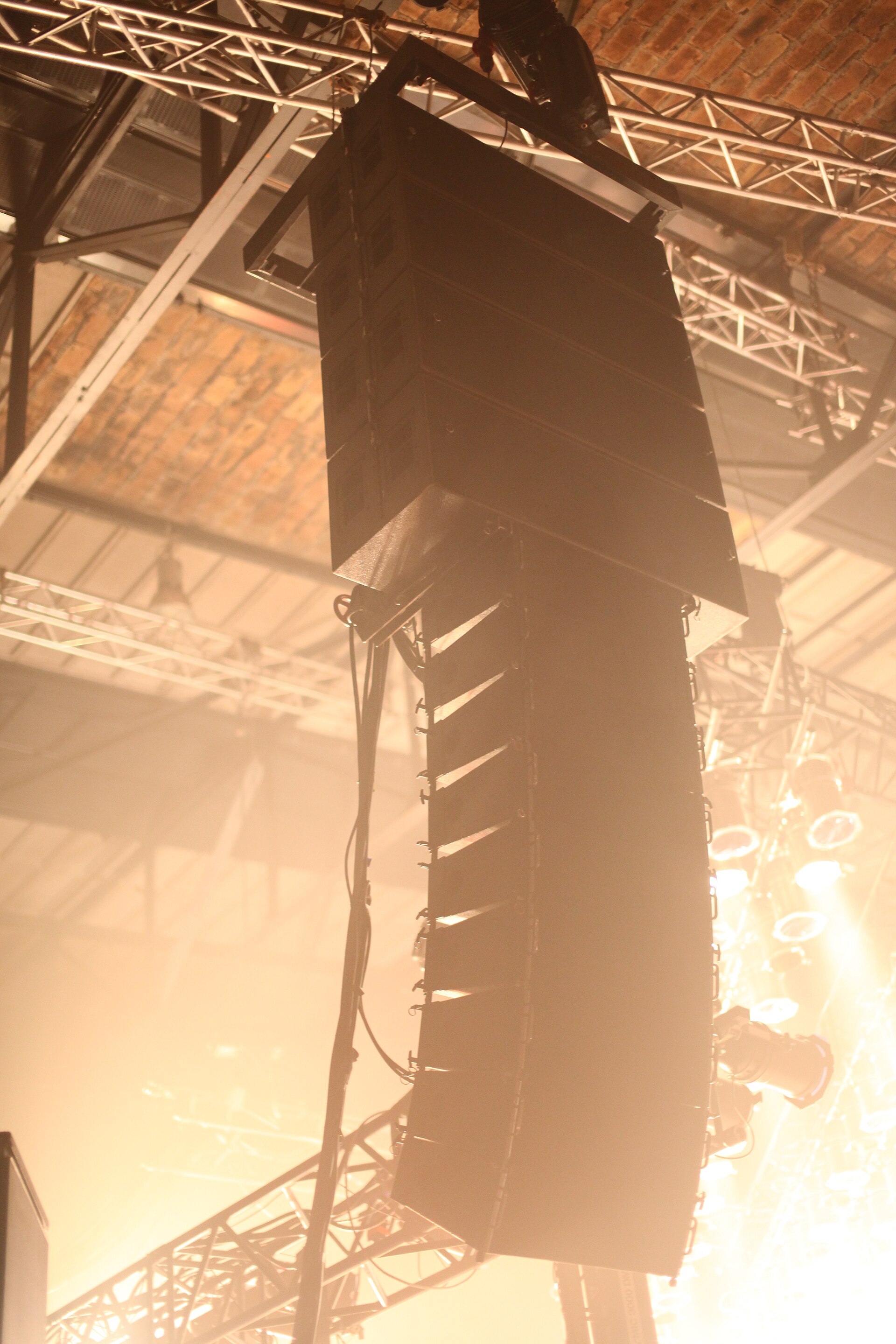
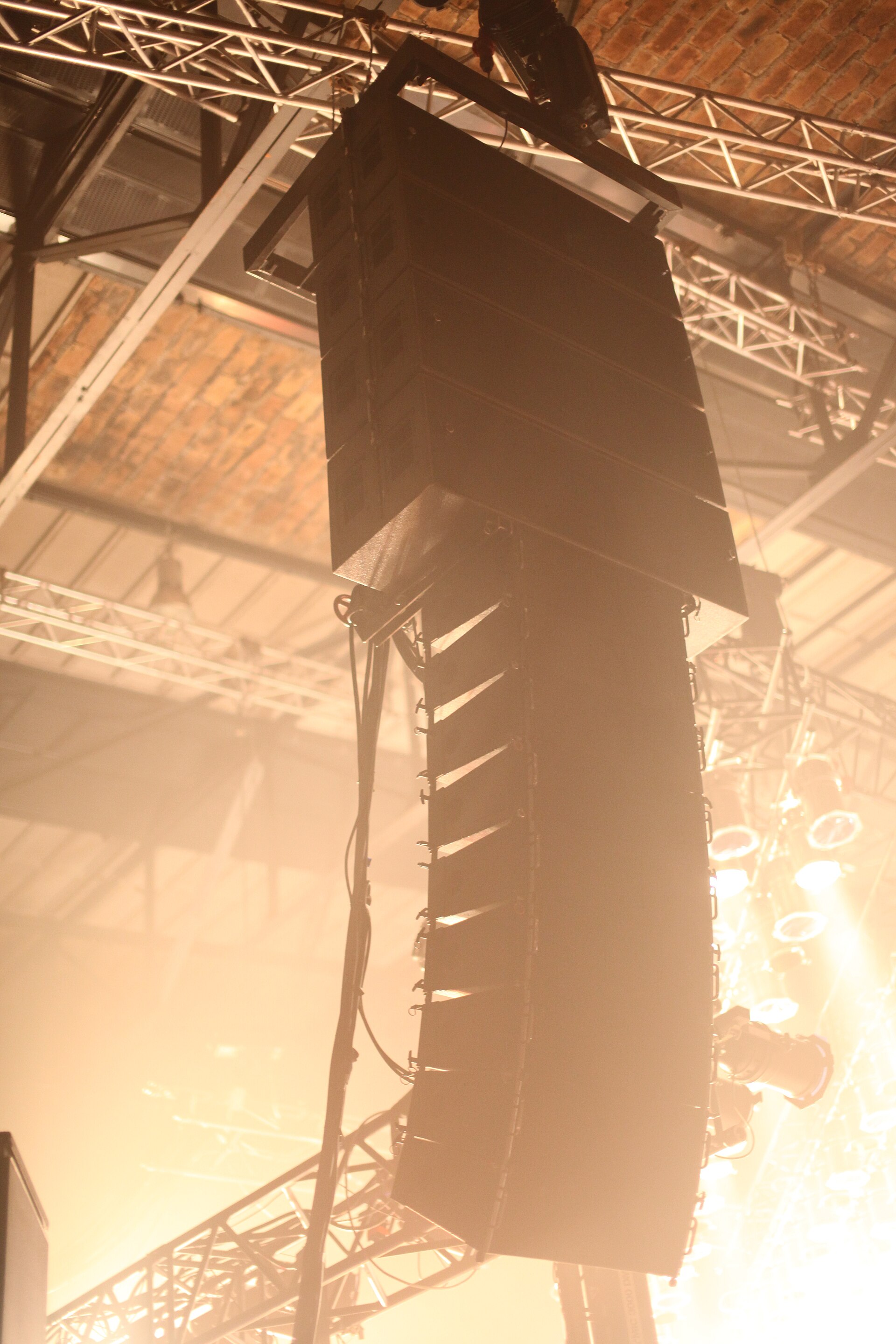
The modern line array did not simply stack more boxes. It coordinated closely spaced sources into a controllable wavefront and supplied prediction tools that connected venue geometry to cabinet angles.
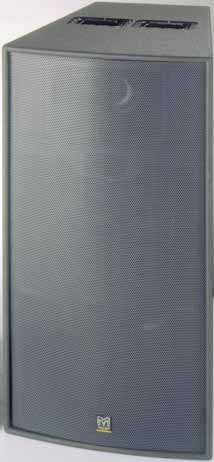
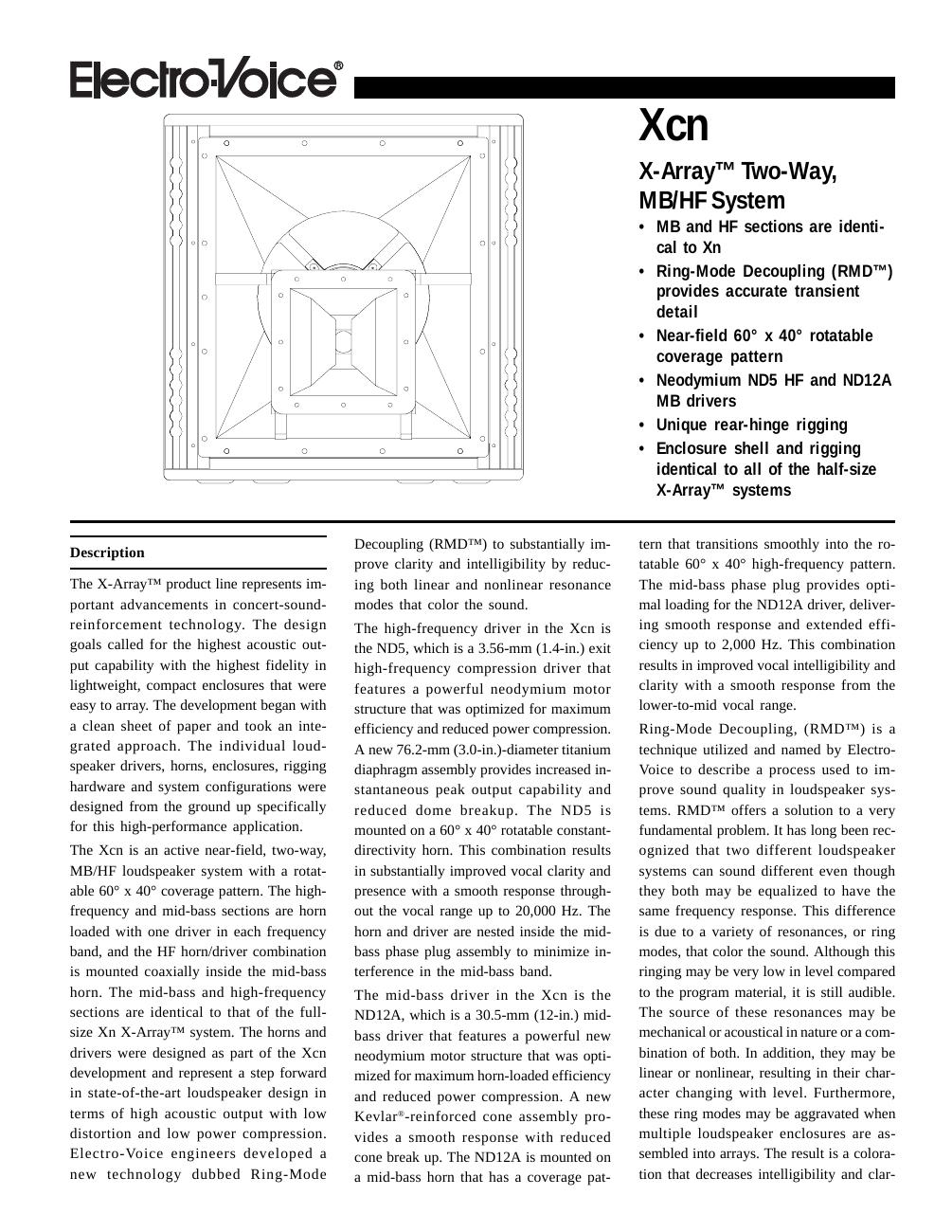
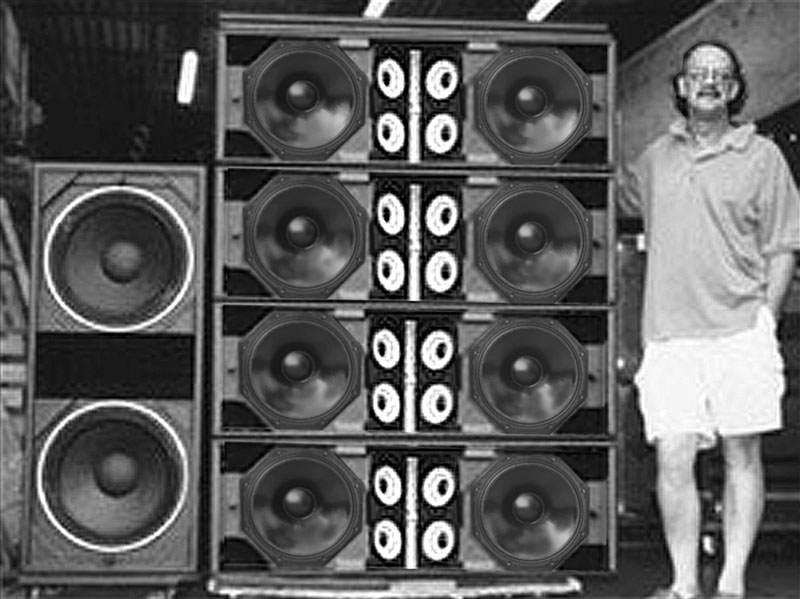
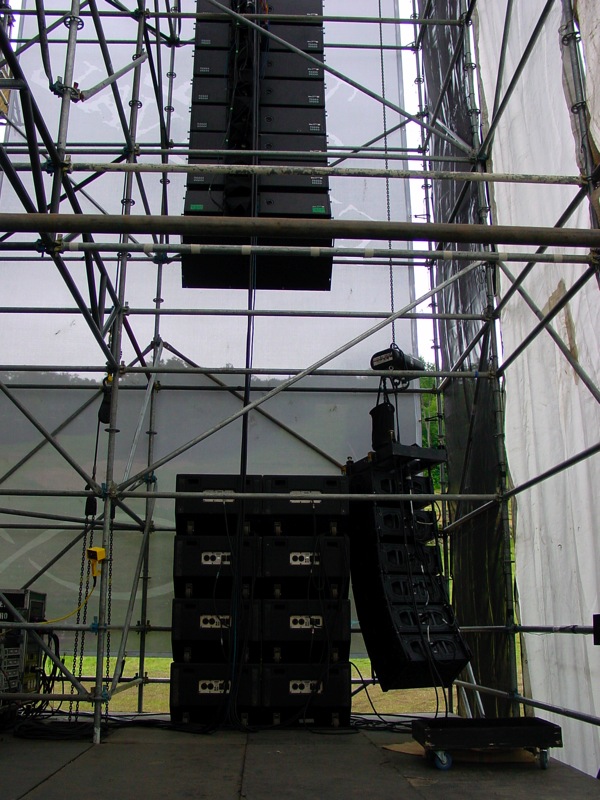
The 1990s were not an overnight replacement of horn boxes by line arrays. Martin Audio's W8 and Electro-Voice's 1997 X-Array represent the continuing refinement of large conventional arrays. Cabinets could be arranged across the horizontal plane and in multiple vertical rows or clusters, with horn patterns and splay angles used to tile the audience. Martin's W8 was a three-way trapezoid cabinet with nominal 55° horizontal dispersion; EV explicitly calls X-Array a traditional horizontal array system. A large vertical stack of those boxes was not automatically a modern line source.
Christian Heil’s Wavefront Sculpture work at L-Acoustics produced V-DOSC in the early 1990s. Closely spaced elements and specialised high-frequency waveguides made adjacent sources couple over their intended operating range. The subsequent ARCS constant-curvature system and smaller dV-DOSC served different applications. Competitors answered with JBL’s VerTec, Meyer’s M3D and MILO, NEXO’s GEO T, EAW KF760, Adamson Y-Axis and Martin W8L. EV's later X-Line was distinct from X-Array, followed by the separate XLC family.
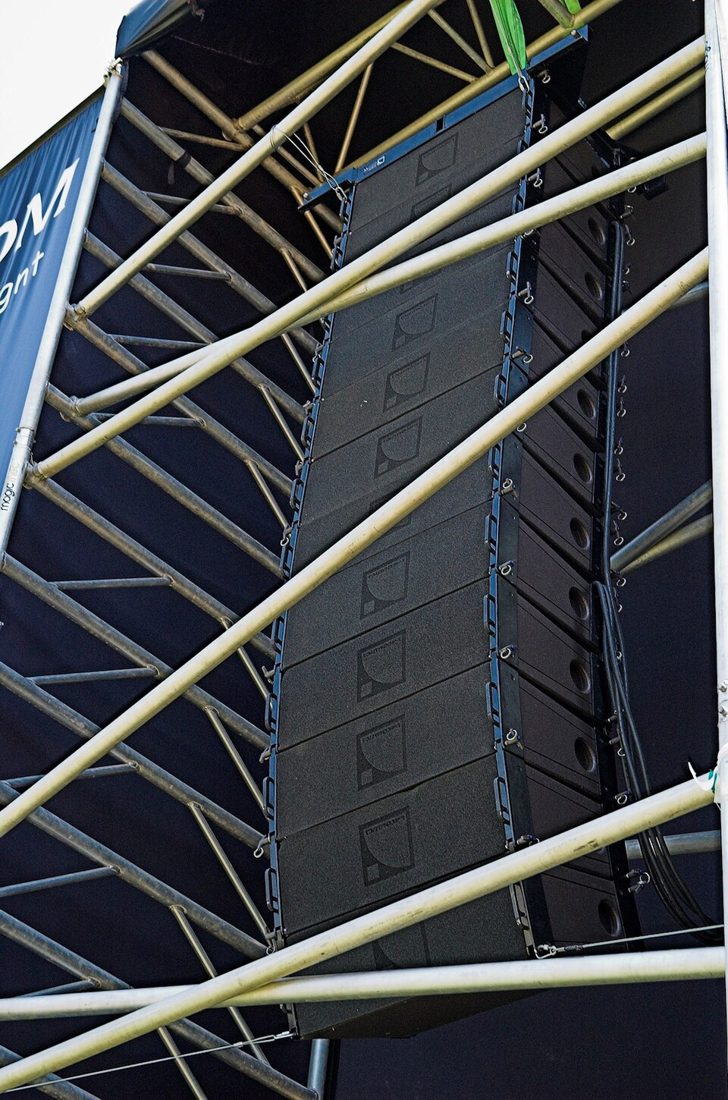
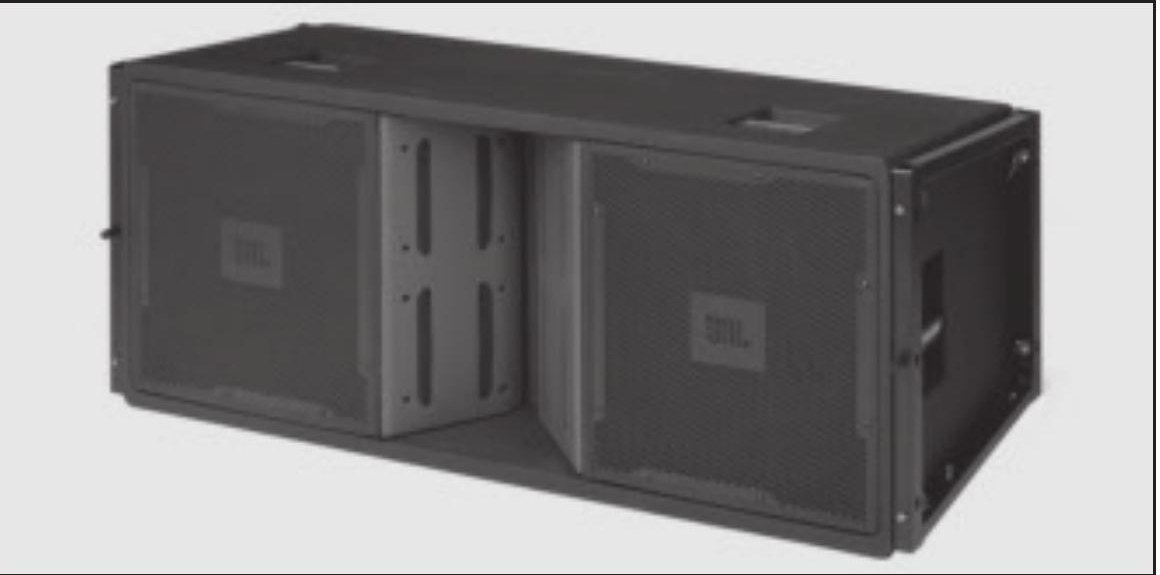
Functionally, the design task shifted from assembling many horn footprints to predicting the behaviour of a coupled vertical aperture. Array length, curvature, element angles, height and processing became interdependent: a gently curved upper section could concentrate energy toward distant seats while a more curved lower section spread it over nearer listeners. Horizontal coverage still depended on the actual cabinet design. Integrated rigging made the chosen geometry repeatable, but a line array still required a suitable engineered suspension and skilled deployment; it did not remove the need for fills, delays or measurement.
For listeners, a well-designed line array could reduce abrupt level and tonal changes between overlapping cabinets and improve consistency from front to back. Conventional clusters could produce audible lobes and cancellations where several horns reached a seat with different arrival times; closely coupled elements addressed some of that interference, not all of it. The result was potentially more even vocal intelligibility and frequency balance—not an inherent guarantee of better sound. Finite arrays are frequency- and distance-dependent: the textbook infinite line source and a universal 3 dB loss per distance doubling do not describe every real seat. Curvature, low-frequency aperture limits, air absorption and room reflections still matter.
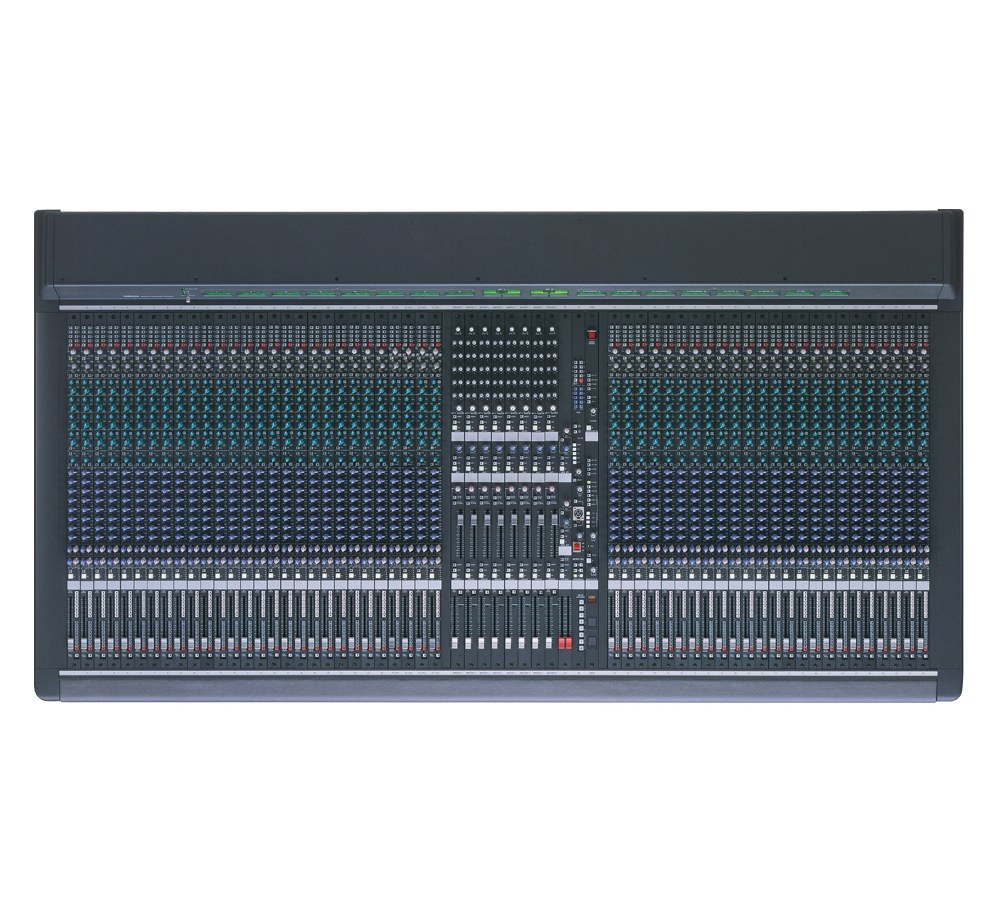
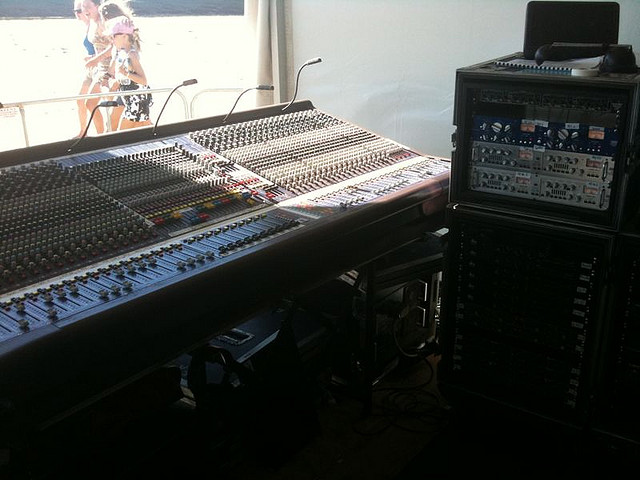
Analogue desks remained central during this transition. The Yamaha PM4000, dated 1992 in Yamaha's museum, and the Midas XL3/XL4 lineage show how VCA grouping, matrix distribution and extensive aux routing supported large 1990s productions. A digital loudspeaker controller did not require a digital mixing desk: an analogue console, outboard rack and DSP-managed PA were a normal hybrid system.
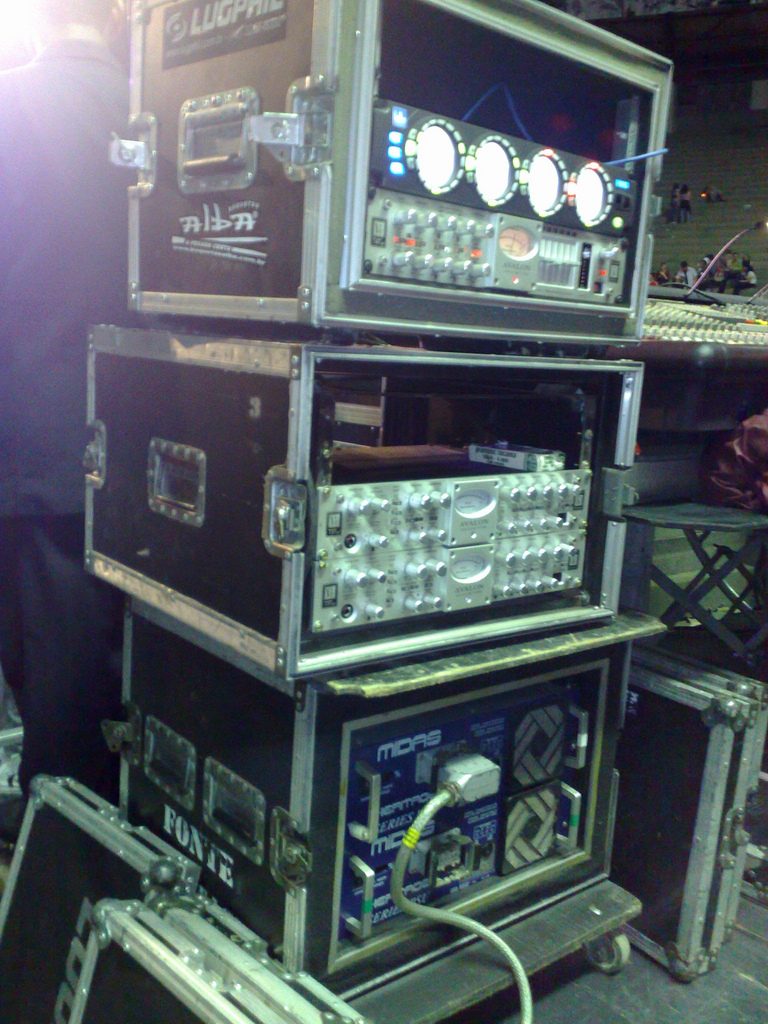
Line arrays needed precise processing and measurement to work. Processors like the Lake Contour and the Dolby Lake Processor combined crossover, delay, EQ and limiting in one box. Measurement systems such as Meyer’s SIM, Smaart and MLSSA compared a reference signal with what reached the audience. Engineers could align arrays, delays and cardioid subwoofers by phase and arrival time rather than by ear alone.
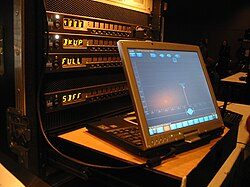 Lake Technology Contour processorBinksternet · CC BY-SA 3.0
 Dolby Dolby Lake ProcessorTiago Cassol Schvarstzhaupt · CC BY 2.0
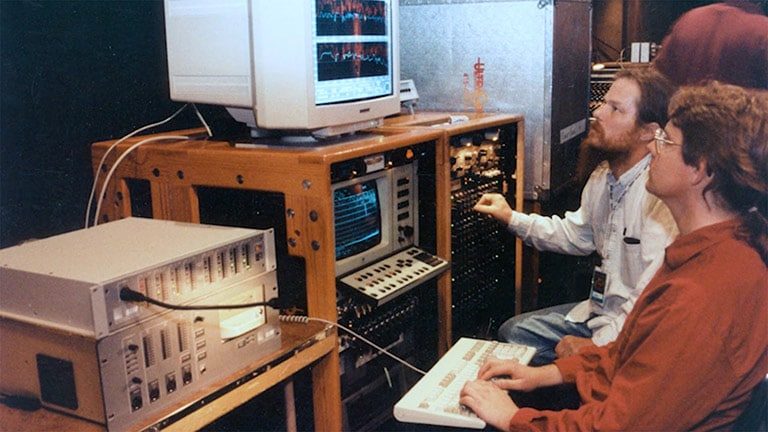 Meyer Sound SIM© Meyer Sound · © Meyer Sound, used for identification and historical commentary
 SIA / Rational Acoustics Smaart measurement platform© Rational Acoustics · © Rational Acoustics, used for identification and historical commentary
Consoles went digital in step. The Yamaha PM1D proved that a touring desk could live in software. The PM5D, DiGiCo D5 Live, VENUE D-Show, Innovason Grand Live and Soundcraft Vi6 added total recall, onboard dynamics and compact digital stage boxes. Those stage boxes raised the next question: how to move many channels between stage, front of house and monitors over a single cable.
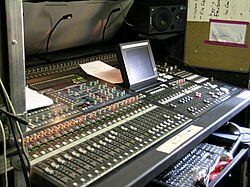
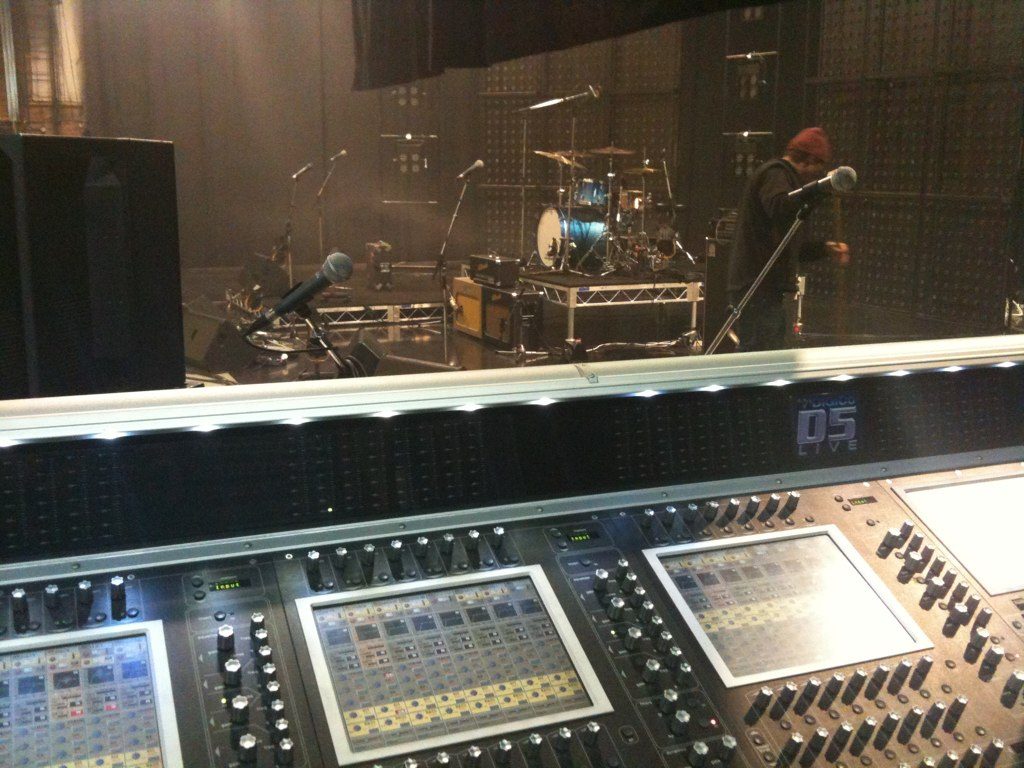
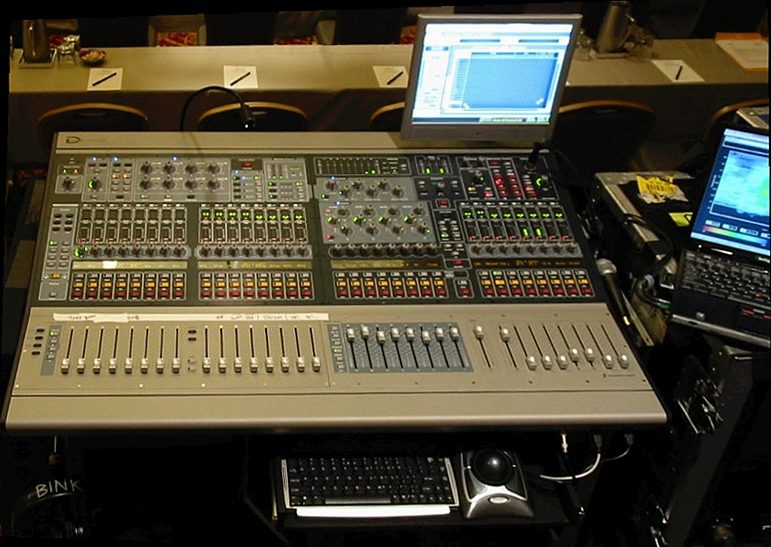
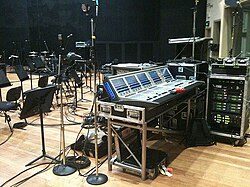
The outboard rack moved inside the console. Yamaha's PM5D included channel processing, eight simultaneous SPX effects and graphic EQ resources; VENUE D-Show hosted TDM plug-ins from the studio world. A vocal compressor no longer needed its own physical insert cable, and a reverb send could feed an internal processor. Scenes stored processing and routing together, allowing a band, song or theatre cue to return to a documented starting point. Fewer external boxes and connections reduced transport and patching work, though large digital systems still included engines, stage racks and other hardware.
The audible gain was control and repeatability, not a law that digital sounds better. More channels could have dedicated dynamics and EQ rather than sharing a limited number of rack units; recalled parameters could reproduce a vocal treatment or delay timing accurately. Different algorithms and analogue circuits still had different characteristics, and engineers could keep favourite external processors. DSP and conversion also introduced latency, with additional plug-ins or external digital paths requiring attention to timing. A saved scene restored settings, not the room, microphone position or performance; ears and measurement remained essential.
Integration changed operational risk. A faulty outboard unit often affected one insert or effect return; a processing-engine failure could affect much more of an integrated mix. Recall scopes and safes became as important as patch labels, because an unintended scene change could alter many channels at once. Backups, redundant system options where provided, known show files and rehearsed recovery became part of professional practice. The rack did not simply vanish: it became smaller, moved into software, or reappeared as a specialist plug-in server or a few deliberately retained hardware units.
Back-of-stage infrastructure standardised in this period as well. Cam-Lok single-pole connectors, an industrial and film-lighting workhorse long before touring reached for them, became the usual way to land feeder cable at the power distribution rack from the mid-1990s, in sizes from 150-amp mini-cams to the 400-amp E1016 and larger maxi-cams. Neutrik answered the fragile IEC inlet with the 1996 powerCON locking mains connector for amplifier and electronics power, and powerCON TRUE1 — rated to connect and break under load to IEC 60320 requirements — reached the US market at the January 2011 NAMM show. And microphone polarity finally settled: AES14, prepared from December 1990, published in 1992 and issued concurrently as ANSI S4.43-1991, fixed pin 2 hot for XLR-type connectors, ending roughly forty years of divided American practice after pin 2 positive had already been standardised internationally by IEC 268-12 in 1975 and endorsed by SMPTE and the EBU in the 1980s.
At the turn of the millennium the line array became a product race. David K. Kennedy's October 2026 FOH survey places JBL's TEC Award-winning VerTec VT4889 in 2000: a light, high-output three-way module with neodymium magnets, beryllium high-frequency diaphragms and carbon-fibre composite construction that helped standardise fast flying of concert rigs. d&b audiotechnik answered in 2002 with the J-Series, a large-format array known for its transparent sound and predictive optimisation software. The same survey records a second path: EAW's 2003 DSA Series and Renkus-Heinz's 2004 ICONYX used a separate amplifier and DSP channel per driver to steer sound electronically from a straight column, aiming energy away from reflective surfaces.
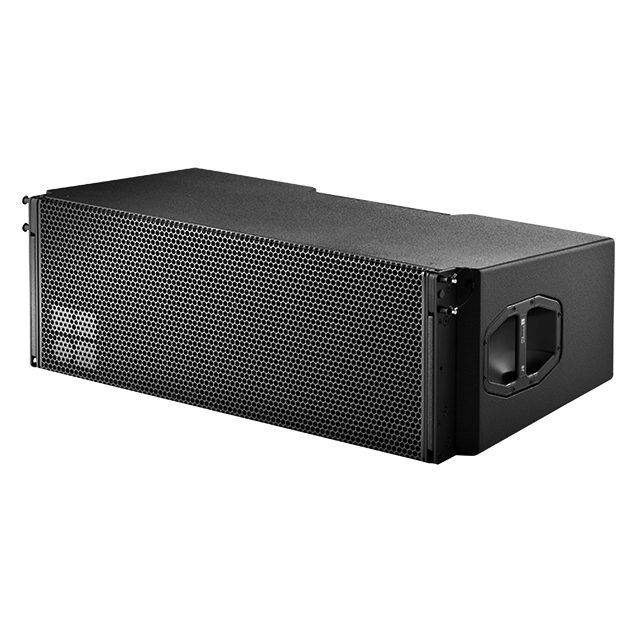
Kennedy's Part 1 survey adds the self-powered and steered branches of the 1990s. Meyer Sound's 1994 MSL-4 put amplification inside a horn-loaded array box, and its PSW-6 used multi-driver geometry as a cardioid subwoofer. JBL's EON, launched at NAMM 1995, made lightweight molded active P.A. widely accessible; Duran Audio's 1996 Intellivox was a digitally steered speech column; EAW's 1997 KF900 combined far-throw and down-fill modules into one steered stadium array; and L-Acoustics' 1997 ARCS brought constant-curvature line-source control to medium-scale venues. Germany produced a different answer in the same years: d&b audiotechnik's C4 system, whose technical documentation dates from 1995, paired a horn-loaded 12-inch/2-inch C4-TOP with a matching 18-inch bandpass C4-SUB and the narrow C3 module, flown on rigging developed with MAN flying systems and driven by d&b's own amplifiers with central computer set-up. British rental firm Entec chose d&b after a 1995 multi-manufacturer shoot-out, and the C4 quickly became a fleet workhorse.
Plates
Documents from the era

Chronology
Milestones
V-DOSC enters the field
L-Acoustics introduces a large-format system built around Wavefront Sculpture Technology.
Pin 2 hot becomes the standard
AES14, issued concurrently as ANSI S4.43-1991, fixes XLR polarity and ends roughly forty years of divided American pin 2/pin 3 practice.
Digital live consoles emerge
Digitally controlled and fully digital desks begin bringing scene recall and integrated processing to touring.
d&b C4 system
d&b audiotechnik documents its modular C4 array system — horn-loaded tops, bandpass subwoofers and dedicated amplifiers with remote control; Entec adopts d&b after a 1995 shoot-out.
Smaart is introduced
Dual-channel FFT measurement becomes broadly accessible to working system engineers.
Thread · Taming the roomLine arrays accelerate
Major manufacturers develop systems around coupled vertical arrays and prediction software.
Directional bass arrays
Touring deployments increasingly use spacing and delay to reduce low-frequency energy behind the stage.
Technical principle
Wavefront sculpture
A line array seeks coherent coupling between adjacent elements while curving the array to distribute sound by audience geometry. Long, gently curved sections project farther; greater curvature spreads energy over nearer seats. Real arrays are finite, frequency-dependent systems—not ideal mathematical line sources.
Simplified signal chain
Working vocabulary
Selected sources
- 01100 Loudspeaker Technologies that Changed Live-Sound History, Part 1 (David K. Kennedy, 6 September 2026) FOH
- 02100 Loudspeaker Technologies that Changed the History of Live Sound, Part 2: Top Product Intros from 2000 to 2026 (David K. Kennedy, October 2026) FOH
- 03Wavefront Sculpture Technology L-Acoustics
- 04SIM System History Meyer Sound
- 05Smaart History Rational Acoustics
- 06W8 archived datasheet Martin Audio
- 07W8L Series application guide: practical line-array behaviour Martin Audio
- 08X-Line and X-Array product catalogue Electro-Voice / Piramis Technika
- 09PM4000-40C Yamaha Innovation Road
- 10PM5D features: effects, dynamics and scene memory Yamaha
- 11Digidesign Ships Venue Live Digital Console CDM
- 12AES14-1992 (r2004) standard text, foreword on XLR polarity history Audio Engineering Society (archived scan)
- 13AES14-1992 (r2014) standards listing Intertek Inform
- 14Power Distro Connections (camlock adoption in touring) FOH Online
- 15Neutrik powerCON TRUE1 debuts stateside at Winter NAMM 2011 Mixonline
Keep going